What Happens in a Structural Investigation (And Why We Take the Plaster Off)

A structural investigation is the point where a structural engineer stops looking at a building and starts looking inside it. Finishes come off, the structure underneath is exposed, and what is actually there gets recorded — rather than what the drawings say should be there.
It is the part of the job most people do not expect. It is also the part that usually settles the question.
What is a structural investigation?
A structural investigation is a targeted opening-up exercise carried out by a structural engineer to establish what a structure is made of, how it carries load, and what is causing a defect such as a crack, a sloping floor or a sagging ceiling. It normally involves removing small, chosen areas of plaster, lifting a few floorboards, or opening part of a ceiling. It is usually commissioned after an inspection or a survey has found something that cannot be diagnosed from the surface.
It is not the same thing as a structural survey. A survey looks, measures and reports. An investigation opens up. If you are not sure which one you have been asked for, our guide to the difference between a structural survey and a structural appraisal sets out where each one applies.
Why it starts with a hammer
Before anything is removed, the wall gets tapped.
Sounding a wall is the oldest diagnostic technique in the trade and it is still the fastest. Solid masonry returns a short, dull knock. A void behind the plaster returns a drum. Blown or delaminated render gives a hollow rattle that is unmistakable once you have heard it a few times.
Thirty seconds of tapping tells an engineer where the solid structure is, where the voids are and — most usefully — where to open up. That last point matters more than it sounds. The whole aim is to remove as little finish as possible while still seeing what has to be seen, and sounding the wall first is what makes that possible.
Why the plaster has to come off
A crack in plaster is not the defect. It is a tracing of the defect.
Plaster is a thin, brittle skin stretched over whatever sits behind it. It has almost no capacity to accommodate movement, so when the structure behind it shifts, the plaster splits — and it splits along the line of whatever is moving. The crack you can see is a faithful drawing of a joint, an edge or a bearing that you cannot.
So the crack tells you where to look. It does not tell you what you are looking at. Our guide to how to read a crack in a wall covers what the shape and direction of a crack suggest. An investigation is how that reading gets confirmed, or corrected.
What was behind this one
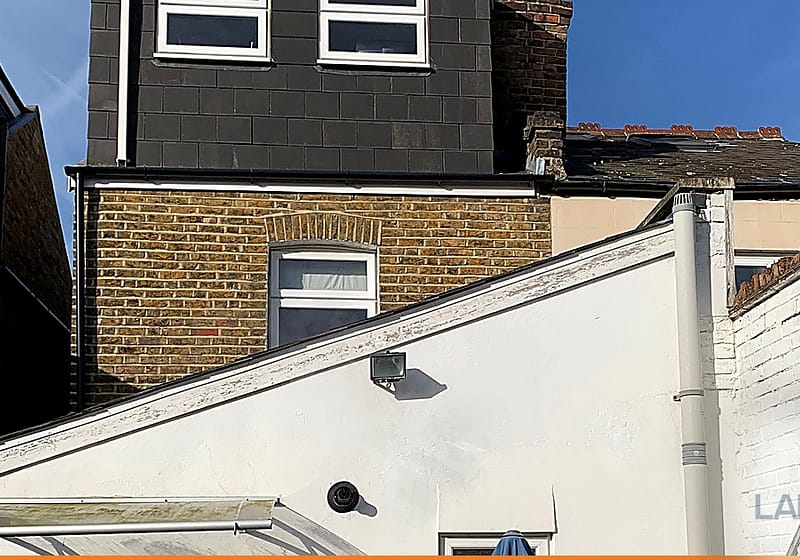
The photograph at the top of this article is from a period property investigation in Peterborough at the end of September.
The reported problem was a fine crack running down from the ceiling. The owner had filled it twice, and both times it had come back in exactly the same line. A crack that returns along its original path is one of the more reliable signals in the business: it means something behind it is still moving.
With the plaster off, the picture was straightforward. The wall above the opening was not solid masonry at all. It was blockwork and rubble built off an old timber bressummer beam, with the two materials meeting at precisely the line the crack had been following.
Old timber and modern blockwork do not behave the same way. Timber takes up and gives off moisture with the seasons and moves as it does so. Blockwork barely moves at all. The difference between them has to go somewhere, and it goes into the joint — where the thin plaster skin bridging the two was comfortably the weakest thing in the assembly.
Nothing was wrong with the filler. The filler was being asked to do a job no filler can do.
Opening up is not damage
This is the objection that comes up most often, and it deserves a direct answer.
The areas removed during an investigation are small, deliberately placed and chosen to sit where making good is cheapest. An engineer who has sounded the wall first can frequently get everything they need from two or three patches about the size of a dinner plate, sited where a skirting, a picture or an existing repair will cover them afterwards.
Set that against the alternative. Without opening up, a repair gets specified on an assumption. If the assumption is wrong, the repair does not hold, the crack returns, and the wall gets opened up anyway — after somebody has already paid for a repair that failed. Making good a patch of plaster is half a day for a plasterer. Doing a structural repair twice is not.
What an investigation tells you that a survey cannot
- What the wall is actually made of. Solid brick, cavity construction, rubble-filled stone, blockwork or timber frame all fail in different ways and all get repaired differently. Painted plaster looks identical over every one of them.
- Where the load really goes. Buildings are rarely loaded the way a drawing suggests, particularly once they have been altered. Opening up shows the real load path.
- Whether somebody has already altered it. Removed chimney breasts, widened openings, beams cut around services and walls taken out without support are all common, and almost none of it appears in the paperwork.
- Whether a beam or lintel is bearing properly. A lintel with insufficient end bearing, or a beam sitting on rubble rather than a padstone, is a defect you can only find by looking at the bearing itself.
- Whether the movement is historic or live. Old movement that stopped decades ago and current movement can produce very similar cracks on the surface. What is happening at the joint behind usually separates the two.
How long it takes
For a single defect in a domestic property, an investigation is typically half a day on site. Larger or less accessible work — several rooms, a roof space, floors that have to come up — can run to a full day.
A written report follows, setting out what was found, what is causing it, and what should be done about it. Where the cause turns out to be ground movement rather than the structure itself, the next step is usually a trial pit to establish what the foundations are sitting on.
When you will be asked for one
Three situations account for most of them.
An insurer has asked for a structural report. Insurers rarely accept a visual opinion where movement is claimed. They want the cause established and the remedy specified. Depending on the outcome, this can also lead to a certificate of structural adequacy once remedial work is complete.
A survey has flagged movement before a purchase. A homebuyer report that recommends further investigation is not a reason to walk away, but it is a reason to find out the number before you commit to it. What happens after a survey recommends a structural engineer is a short process, and it is usually worth doing before exchange rather than after.
A crack keeps coming back. Filled once is decorating. Filled three times is a structural question that has not been asked yet. Where the crack sits at the junction between an original house and a later addition, cracks where an extension meets the house covers what that particular pattern usually means.
Frequently asked questions
What is a structural investigation?
It is an opening-up exercise carried out by a structural engineer to establish what a structure is made of and what is causing a defect. Small areas of plaster, floor or ceiling are removed so the structure behind can be seen and recorded, and a report follows setting out the cause and the remedy.
Is a structural investigation the same as a structural survey?
No. A structural survey is a visual inspection with measurements and a report. A structural investigation goes further and physically exposes the structure. A survey often recommends an investigation; an investigation is rarely the first step.
Will you damage my walls?
Small areas of finish are removed, positioned where making good is simplest and least visible. Sounding the wall beforehand keeps the number and size of those areas down. Everything removed is replaceable by a plasterer and decorator in the ordinary way.
How much plaster has to come off?
Usually far less than people expect. Two or three patches are often enough for a single defect, because the aim is to see specific things — a bearing, a joint, a lintel end — rather than to expose a whole wall.
Do I need one for an insurance claim?
Frequently, yes. Where movement or subsidence is claimed, insurers generally require the cause to be established and the remedy specified by a structural engineer before they will deal with the claim.
Can you tell whether movement is still happening?
Often, from what the joint behind the plaster looks like. Where it is genuinely ambiguous, crack monitoring over a period of months settles it, and that can be set up at the same visit.
What to do next
If you have a crack that has come back after filling, a floor that has started to fall away at one end, or a survey that has recommended further investigation, the useful next step is for somebody to come and tap the wall. It is a short visit and it usually answers the question.
Ora Labora Structural Engineers carry out structural investigations, structural surveys, subsidence surveys and structural reports for insurance companies as structural engineers in Peterborough and structural engineers in London. Call +44 1733 602 844 or book a consultation and we will come and look at what is behind it.
Have a question about your own project?
Send us a drawing or a photo and an engineer will tell you what is possible.
Book a consultation